

Introduction
If you’ve been researching natural ways to support your child with ADHD, you’ve probably wondered which magnesium supplement is best. Parents often come across terms like magnesium glycinate, magnesium L-threonate, and magnesium citrate, but knowing which one actually works best for kids with ADHD can be confusing. This article will give you a clear comparison: magnesium glycinate vs L-threonate vs citrate for ADHD kids.
Magnesium is one of the most essential minerals for brain and nervous system health. For children with ADHD, it may help improve focus and concentration, reduce restlessness and hyperactivity, and support better sleep routines. However, not all forms of magnesium are absorbed the same way. Some are gentler on the stomach, while others directly support memory and learning.
In this guide, we’ll compare the differences between magnesium glycinate, L-threonate, and citrate—explaining their benefits, pros and cons, and the best option for ADHD children.
Want a full list of safe products and dosage tips? Don’t miss our Best Magnesium Supplements for ADHD Child (2025 Guide).
Why Magnesium Matters for ADHD Kids
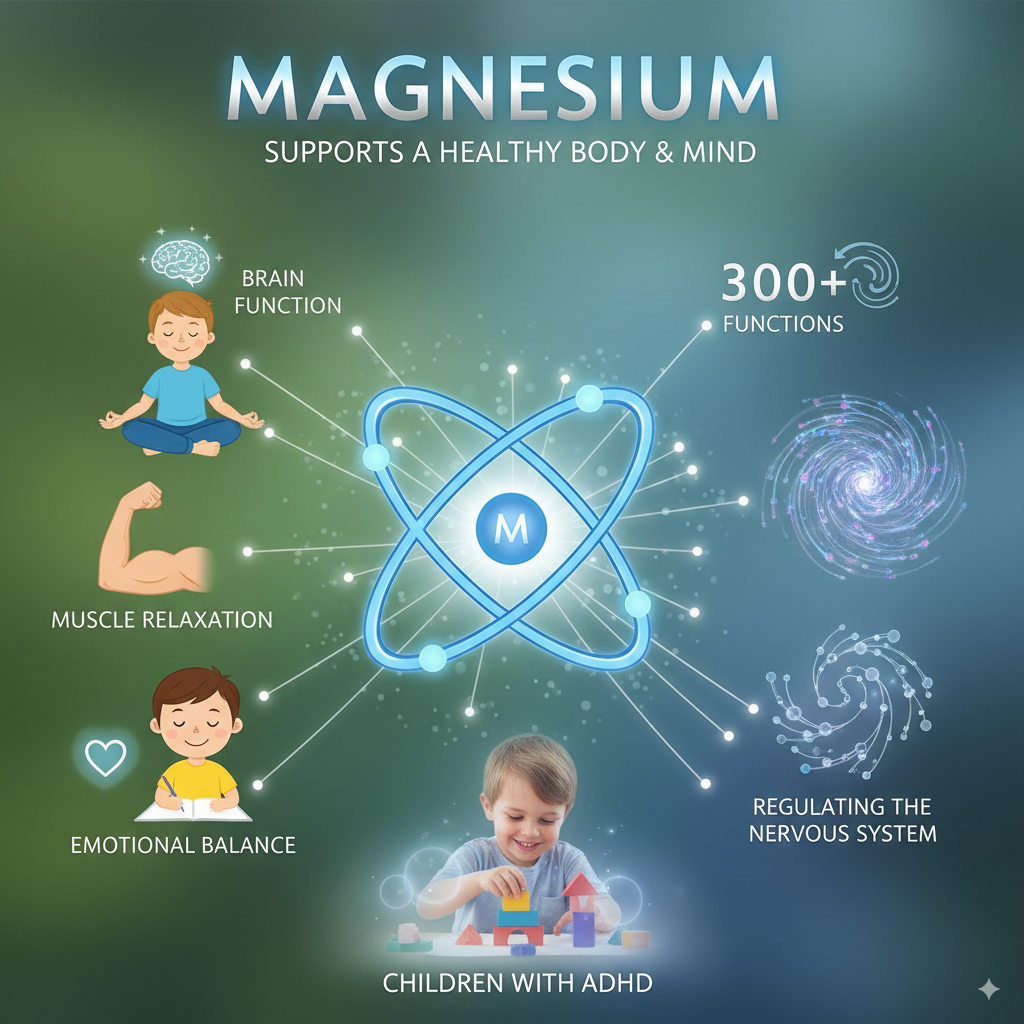
Magnesium is a mineral that supports more than 300 functions in the human body, from muscle relaxation to brain activity. For children with ADHD, magnesium plays a critical role in regulating the nervous system, supporting brain function, and maintaining emotional balance.
Several studies suggest that kids with ADHD are more likely to have low magnesium levels, which can make symptoms worse. A deficiency may contribute to poor concentration, restlessness, hyperactivity, and even sleep problems. These are challenges most parents of ADHD children know all too well.
When magnesium levels are balanced, parents often notice improvements in:
- Focus and attention during schoolwork or daily activities
- Sleep quality, making bedtime easier
- Calmness and behavior, reducing irritability
- Overall mood stability, supporting emotional well-being
Different forms of magnesium—like magnesium glycinate, magnesium L-threonate, and magnesium citrate—are now widely used by parents looking for natural support. Each form works in slightly different ways: some are better for calming hyperactivity, others for improving memory and focus, and some for digestive support.
Magnesium Glycinate for ADHD Kids
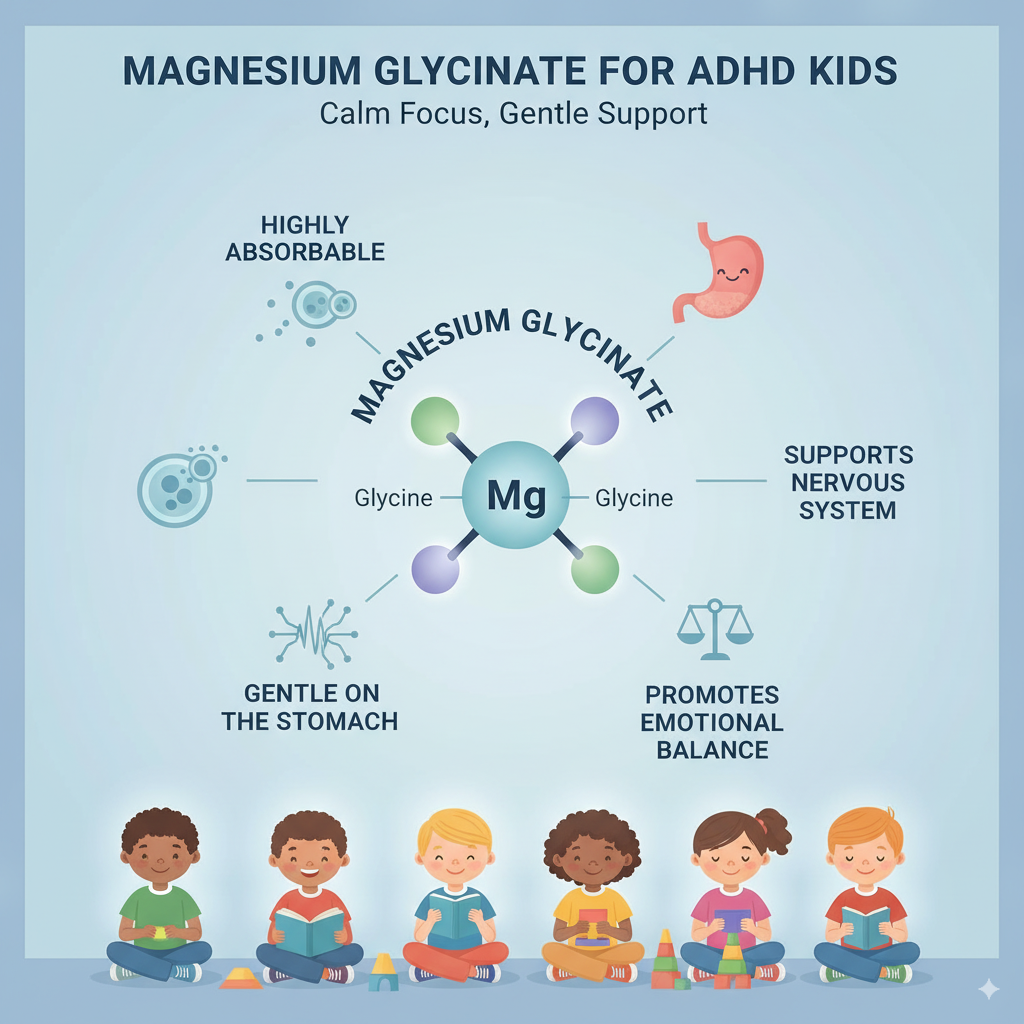
One of the most popular and highly recommended forms of magnesium for ADHD children is magnesium glycinate. This form is created by binding magnesium with the amino acid glycine, which makes it highly absorbable and gentle on the stomach. Parents often turn to this type when they want a supplement that supports both the nervous system and emotional regulation.
✅ Why Magnesium Glycinate Works for ADHD
- Calming effect: Magnesium glycinate is well-known for its ability to reduce restlessness and hyperactivity by calming the brain and supporting neurotransmitter balance.
- Supports sleep: Many parents report that their child falls asleep faster and stays asleep longer when using this form. Better sleep quality often translates into improved focus and concentration during the day.
- Gentle on the stomach: Unlike magnesium citrate, which can sometimes cause loose stools, glycinate is usually easier for children with sensitive digestion.
✅ Pros of Magnesium Glycinate
- High bioavailability (absorbs well in the body)
- Gentle and safe for daily use
- Helps with anxiety, irritability, and mood swings
- Often recommended for kids who have trouble falling asleep
⚠️ Cons of Magnesium Glycinate
- Usually more expensive than other forms
- Comes mainly in capsule form, which may be hard for younger kids to swallow (though some brands now offer gummies or powders)
💡 Who Should Try Magnesium Glycinate?
Magnesium glycinate may be the best magnesium for ADHD children who struggle with:
- Anxiety and mood imbalance
- Difficulty sleeping or bedtime battles
- High levels of restlessness or hyperactivity
- Behavioral outbursts tied to stress
If your child’s main challenge is emotional regulation and sleep problems, glycinate may be the most effective choice. For children who need more direct cognitive support, however, magnesium L-threonate may be a better fit—which we’ll cover in the next section.
Magnesium L-Threonate for ADHD Kids
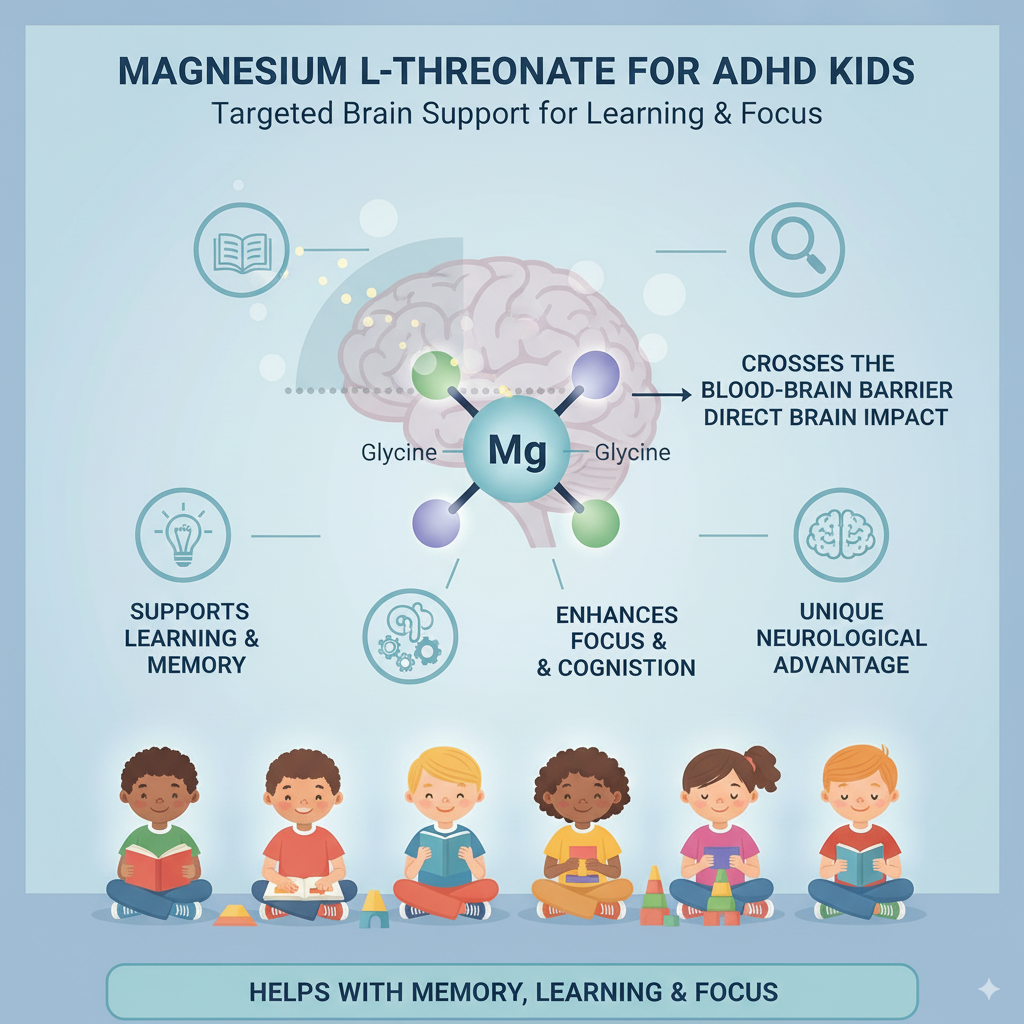
Another form that is gaining popularity among parents and researchers is magnesium L-threonate. Unlike other types, this form has a unique advantage: it can cross the blood–brain barrier, which means it directly affects the brain. Because of this, many parents consider it the best magnesium for ADHD children who struggle mainly with memory, learning, and focus.
✅ Why Magnesium L-Threonate Works for ADHD
- Supports brain function: L-threonate increases magnesium levels in the brain, which may improve cognitive performance and support better learning skills.
- Improves focus and attention: Some studies suggest it may help children stay more focused during schoolwork and reduce distractibility.
- May enhance memory: Because it directly works in the brain, L-threonate is often linked to improved working memory and long-term recall.
✅ Pros of Magnesium L-Threonate
- Penetrates the nervous system and brain more effectively
- Backed by growing scientific research
- Useful for kids who mainly struggle with attention span and learning
- Often marketed as “Magtein®,” a patented version studied in brain health
⚠️ Cons of Magnesium L-Threonate
- Usually the most expensive magnesium form on the market
- Capsule size may be difficult for young children
- Fewer studies in children compared to adults (though early results are promising)
💡 Who Should Try Magnesium L-Threonate?
This form may be the right choice if your child’s biggest challenges are:
- Poor concentration during school
- Forgetfulness and weak memory skills
- Struggles with learning new material
- Needing extra support with cognitive development
If your child has strong symptoms of hyperactivity, restlessness, or sleep problems, magnesium glycinate might be more effective. But if your main goal is to boost focus, memory, and learning ability, then L-threonate is worth considering despite its higher cost.
Magnesium Citrate for ADHD Kids
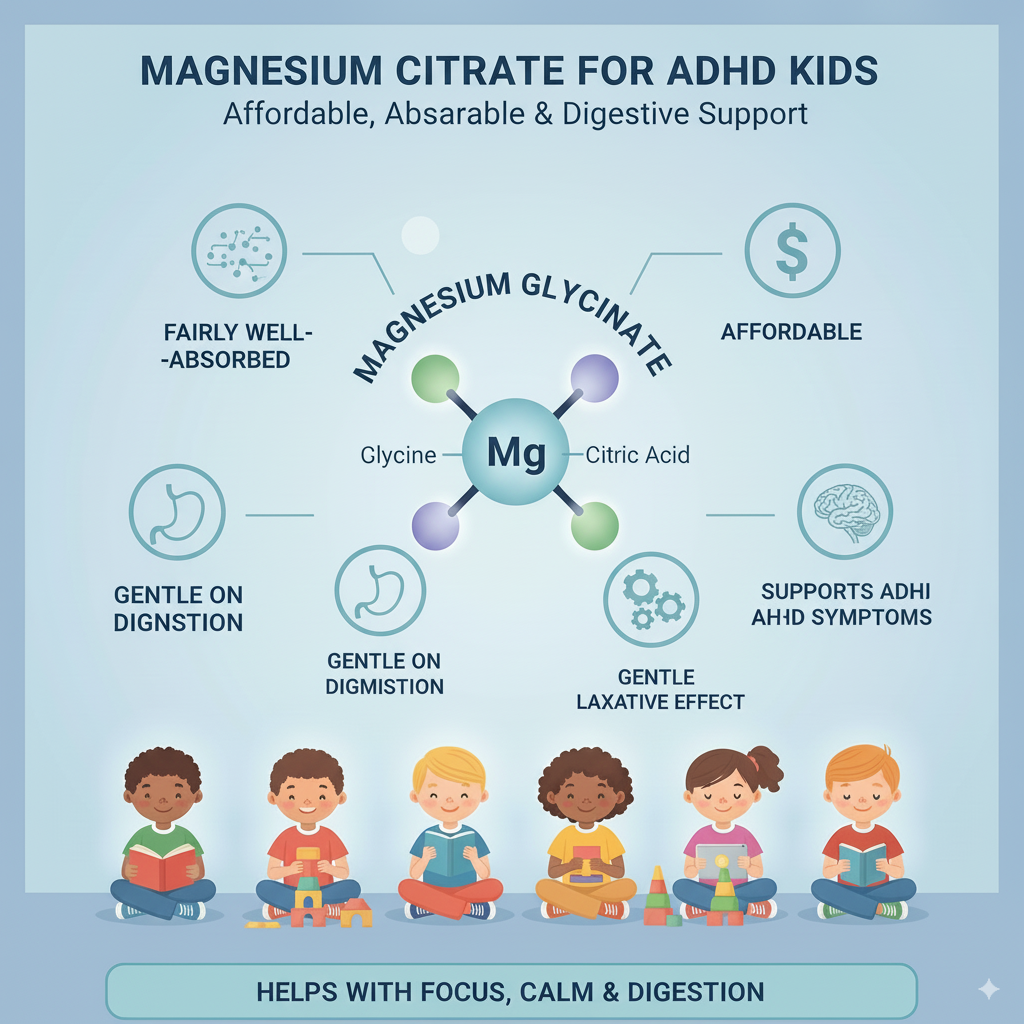
The third commonly used form is magnesium citrate. This type is created by combining magnesium with citric acid, which makes it fairly well-absorbed and affordable. Many parents choose citrate not only for its benefits with ADHD symptoms but also for its gentle effect on digestion.
✅ Why Magnesium Citrate Works for ADHD
- Supports focus and calmness: Like other forms, citrate provides the magnesium the body needs to balance the nervous system, which may reduce restlessness and improve attention span.
- Helps with constipation: Many children with ADHD also struggle with digestive issues. Magnesium citrate has a mild laxative effect, making it useful for kids who deal with both ADHD symptoms and irregular bowel movements.
- Affordable and accessible: It’s one of the most widely available magnesium supplements in the U.S., making it easier for families to find and try.
✅ Pros of Magnesium Citrate
- Good bioavailability (absorbs better than oxide)
- Dual benefit: supports ADHD behavior + improves digestion
- Often available in gummy, powder, or chewable forms
- Less expensive than glycinate or L-threonate
⚠️ Cons of Magnesium Citrate
- May cause loose stools or stomach discomfort if taken in higher doses
- Not as calming as glycinate or as brain-focused as L-threonate
- Can be tricky to balance the dose for kids with sensitive stomachs
💡 Who Should Try Magnesium Citrate?
Magnesium citrate may be the best magnesium for ADHD kids who:
- Need support with focus and attention but also have digestive issues
- Prefer powder or gummy supplements instead of capsules
- Are just starting with magnesium and parents want a budget-friendly option
If your child mainly needs help with sleep problems or anxiety, then magnesium glycinate may be a better fit. And if the biggest struggle is memory and learning, L-threonate might be worth the higher cost.
Side-by-Side Comparison: Glycinate vs L-Threonate vs Citrate
Choosing the right magnesium supplement for an ADHD child can feel overwhelming. To make it easier, here’s a quick comparison table showing the main differences between magnesium glycinate, magnesium L-threonate, and magnesium citrate.
| Magnesium Type | Absorption | Best For | Pros | Cons |
| Glycinate | High | Calmness, sleep support, mood balance | Gentle on stomach, reduces anxiety and restlessness, improves sleep quality | More expensive, usually in capsule form |
| L-Threonate | High (Brain) | Focus, learning, memory, attention span | Crosses the blood–brain barrier, backed by research, supports cognitive development | Costly, fewer child-specific studies, capsule size may be large |
| Citrate | Medium | ADHD + digestion support | Affordable, helps with digestive issues, available in gummies/powders | May cause loose stools, less calming than glycinate, less brain-focused than threonate |
Which One Should Parents Choose?
Now that we’ve compared the main types, you might still be wondering: Which magnesium supplement is right for my child with ADHD? The answer depends on your child’s specific symptoms and needs.
- ✅ Magnesium Glycinate – Best if your child struggles with restlessness, hyperactivity, mood swings, or sleep problems. It has a calming effect and is gentle on the stomach.
- ✅ Magnesium L-Threonate – Best for kids who need extra help with focus, memory, learning skills, and attention span. Since it crosses the blood–brain barrier, it directly supports brain health.
- ✅ Magnesium Citrate – Best if your child needs general ADHD support but also has digestive issues like constipation. It’s affordable and available in kid-friendly forms such as powders and gummies.
For many parents, the choice also comes down to budget and convenience. Glycinate and L-threonate tend to be more expensive but may give stronger benefits, while citrate is cheaper and easier to find.
👉 Remember: magnesium is not a cure for ADHD, but it can be a helpful addition to your child’s overall wellness plan. The safest approach is to start with a low dose, monitor changes in focus, behavior, and sleep, and always consult your pediatrician before making supplement changes.
By matching the right type of magnesium to your child’s main challenges, you can support their nervous system, emotional balance, and cognitive development in a natural and safe way.
Conclusion
Choosing between magnesium glycinate, magnesium L-threonate, and magnesium citrate can feel confusing at first, but the key is to match the supplement to your child’s main challenges. Glycinate is excellent for calmness, mood balance, and better sleep. L-threonate is ideal for focus, memory, and learning support, while citrate works best for kids who need both ADHD symptom relief and digestive help.
No matter which form you choose, magnesium should be seen as a supportive tool, not a replacement for ADHD treatment plans like therapy or prescribed medication. Start slowly, watch for changes in your child’s behavior, sleep, and concentration, and always check with a pediatrician before adding any supplement.
👉 For a complete list of the best magnesium supplements for ADHD children—including product recommendations and dosage tips—check out our Best Magnesium Supplements for ADHD Child (2025 Guide).
FAQs for Parents
1. What is the best magnesium for ADHD children?
The best magnesium depends on your child’s needs. Magnesium glycinate works well for calming, sleep, and mood balance. Magnesium L-threonate is better for focus and memory because it crosses the blood–brain barrier. Magnesium citrate helps with both ADHD symptoms and digestion but may cause loose stools in higher doses.
2. Can magnesium help with ADHD symptoms in kids?
Yes. Research shows many ADHD children have low magnesium levels, which can affect focus, behavior, and sleep. Supplementing with the right form of magnesium may improve attention span, calmness, and sleep quality. It’s not a cure, but it can be an effective natural support alongside therapy and medical treatment.
3. Is magnesium glycinate or citrate better for ADHD?
For restlessness, anxiety, and sleep problems, magnesium glycinate is usually the better choice. For children who also deal with digestive issues like constipation, magnesium citrate may be more helpful. Both forms support ADHD symptoms, but glycinate is often gentler on the stomach and better for calming.
4. How much magnesium should a child with ADHD take?
Dosage depends on age. U.S. guidelines suggest around 130 mg daily for ages 4–8 and 240 mg for ages 9–13 (from both food and supplements). Always check labels for elemental magnesium and consult a pediatrician before starting, since too much can cause stomach upset or diarrhea.
5. Does magnesium L-threonate really help with focus?
Yes. Unlike other forms, magnesium L-threonate raises magnesium levels in the brain, which may improve working memory, learning ability, and concentration. Some studies show positive results, though research in children is still limited. Parents often choose this form when focus and school performance are the main concerns.


